
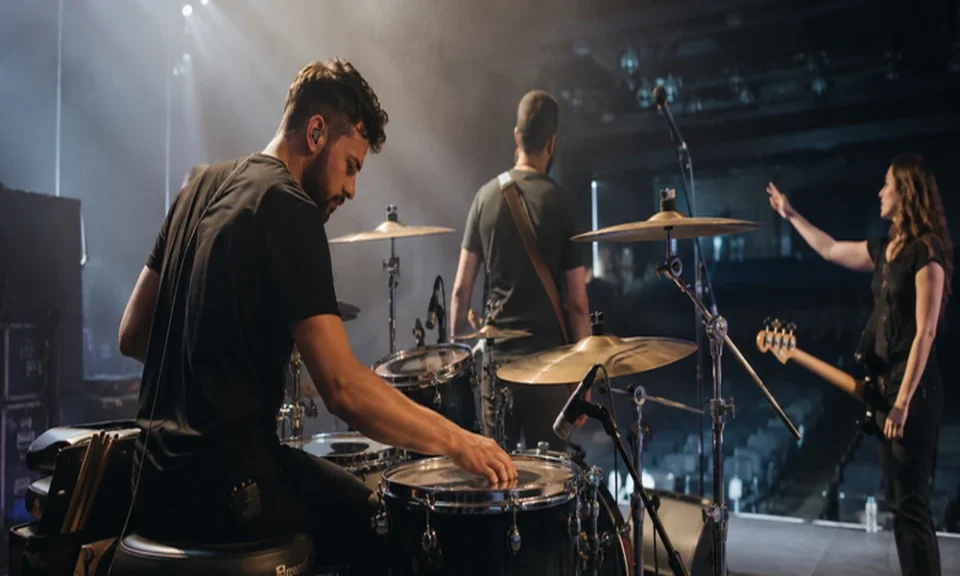
A drummer can spend years developing speed, coordination, and impressive fills yet still feel unprepared when stepping onto a stage with other musicians. Live performance demands a different combination of abilities. Technique matters, but so do listening, consistency, adaptability, preparation, and knowing when not to play.
For drummers who want to become dependable performers, the goal is therefore bigger than building chops. It is learning how to make musical decisions while supporting everyone else on stage.
Build Timing That Survives Real Performance Pressure
Practicing with a metronome is valuable because it exposes inconsistencies that might otherwise go unnoticed. Stage-ready timing, however, requires more than staying aligned with a click.
A performing drummer needs to maintain a convincing pulse while listening to the bassist, responding to a vocalist, following an arrangement, and recovering smoothly when something unexpected happens.
One useful practice method is to make the click less dominant over time. Instead of relying on constant subdivisions, practice with fewer reference points and force yourself to maintain the space between them. Recording these sessions can reveal whether the groove remains stable or gradually speeds up and slows down.
It is also worth practicing transitions rather than only isolated patterns. Moving cleanly from a verse into a chorus, changing dynamics without disturbing the tempo, and returning confidently after a stop can be more useful in a real performance than executing a difficult fill.
The test of timing is not simply whether the drummer can play accurately. It is whether the other musicians can comfortably build their parts around the pulse.
Develop Musical Vocabulary, Not Just More Chops
Technical ability gives drummers options. Musical vocabulary helps them choose the right one.
A player who knows only one approach to rock, funk, jazz, R&B, or another style may struggle when the musical situation changes. Developing familiarity with different grooves, articulations, dynamics, song forms, and feels makes it easier to understand what a particular piece of music is asking for.
This does not mean trying to become an expert in every genre at once. A better approach is to study styles deliberately.
Choose a recording and identify the drummer’s role. Listen to the relationship between the kick drum and bass, where the snare sits, how the hi-hat or ride shapes the subdivision, and how the part changes between sections. Then learn enough of the arrangement to play along without treating the exercise as a drum solo.
That process develops musical judgment alongside technique.
Versatility also means becoming comfortable changing intensity without automatically adding more notes. Sometimes the most effective way to lift a chorus is a stronger backbeat, a more open cymbal sound, or a subtle change in orchestration rather than a complicated fill.
Learn to Rehearse Like a Working Musician
Individual practice is essential, but some performance skills only become obvious when another musician is involved.
Ensemble playing forces a drummer to listen outward. You may need to change a groove because the bass part is busier than expected, leave additional space for a vocalist, follow a musical director’s cue, or simplify something that sounded impressive in the practice room but does not serve the arrangement.
That is why aspiring performers should deliberately seek situations where rehearsal and feedback are part of the learning process. For players considering more structured preparation, a drum performance program can be one way to develop technique while regularly applying those skills in musical and performance contexts.
Whatever training route a drummer chooses, rehearsals should be treated as more than opportunities to run through songs. They are opportunities to develop professional habits.
Arrive knowing the material. Keep useful notes about arrangements. Mark difficult transitions. Learn how songs begin and end instead of assuming someone else will provide a cue. If a change is requested, write it down and demonstrate that you can apply feedback on the next run-through.
These habits may be less exciting than learning a new fill, but they make rehearsals more efficient and help establish trust between musicians.
Prepare for the Musical Situations Modern Drummers Encounter
Stage readiness also involves becoming comfortable with tools and situations that extend beyond an acoustic kit.
A drummer may encounter backing tracks, click tracks, electronic sounds, recording sessions, charts, programmed elements, or hybrid setups. There is no need to master every piece of technology immediately, but avoiding these areas entirely can narrow a player’s flexibility.
Recording yourself is an especially practical place to start. Even a simple recording can reveal uneven dynamics, rushed fills, inconsistent note placement, or cymbals overpowering the rest of the kit.
Drummers should also practice learning material efficiently. Try listening through a song once without playing, identifying its form, and writing a basic roadmap. Then return to the kit and see how much of the arrangement you can reproduce.
This builds a skill that matters whenever rehearsal time is limited: arriving prepared rather than using group rehearsal to learn material that could have been studied beforehand.
Professionalism ultimately connects all of these abilities. Being prepared, listening closely, adjusting quickly, and supporting the music can make technical skill far more useful.
Conclusion
Becoming stage-ready is not about eliminating every mistake or developing the most advanced vocabulary possible. It is about becoming the kind of drummer other musicians can rely on.
Strong timing provides the foundation. Stylistic awareness helps you make appropriate musical choices. Ensemble experience teaches you to listen and adapt. Preparation and familiarity with modern performance tools make you more flexible when circumstances change.
Technique remains important, but its real value appears when it can be used in service of a song. For a developing drummer, the most productive question is not simply, “What can I play?” It is, “Can I make the music around me work better?”
